







New on-chain analysis of Polymarket indicates that headline loss figures tell an incomplete story. According to defioasis.eth, roughly 70% of Polymarket’s 1.7 million trading addresses have realized losses, while close to 30% have booked profits.
At face value, this resembles the familiar pattern seen in retail CFD markets, where the majority of participants lose money.
A closer examination shows that most losses are relatively small, while gains are heavily concentrated among a small group of skilled participants who get the bulk of the upside.
Of the more than 1.7 million addresses analyzed, over 1.1 million, representing 63.5% of all participants, recorded realized losses between $0 and $1,000.
Losses are widespread, but usually limited
Severe losses do exist, but they are rare. Only around 140 addresses recorded realized losses exceeding $1 million, indicating that extreme downside is concentrated among a very small group of users.
This distribution contrasts with narratives that frame prediction markets as uniformly destructive for retail users. Instead, the data points to a system where casual participants lose small amounts while providing liquidity for more advanced traders.
Where the imbalance becomes concerning is on the profit side. Fewer than 0.04% of all Polymarket addresses have more than 70% of total realized profits, collectively earning around $3.7 billion. These top performers operate at a scale and frequency that sets them apart from the broader user base.
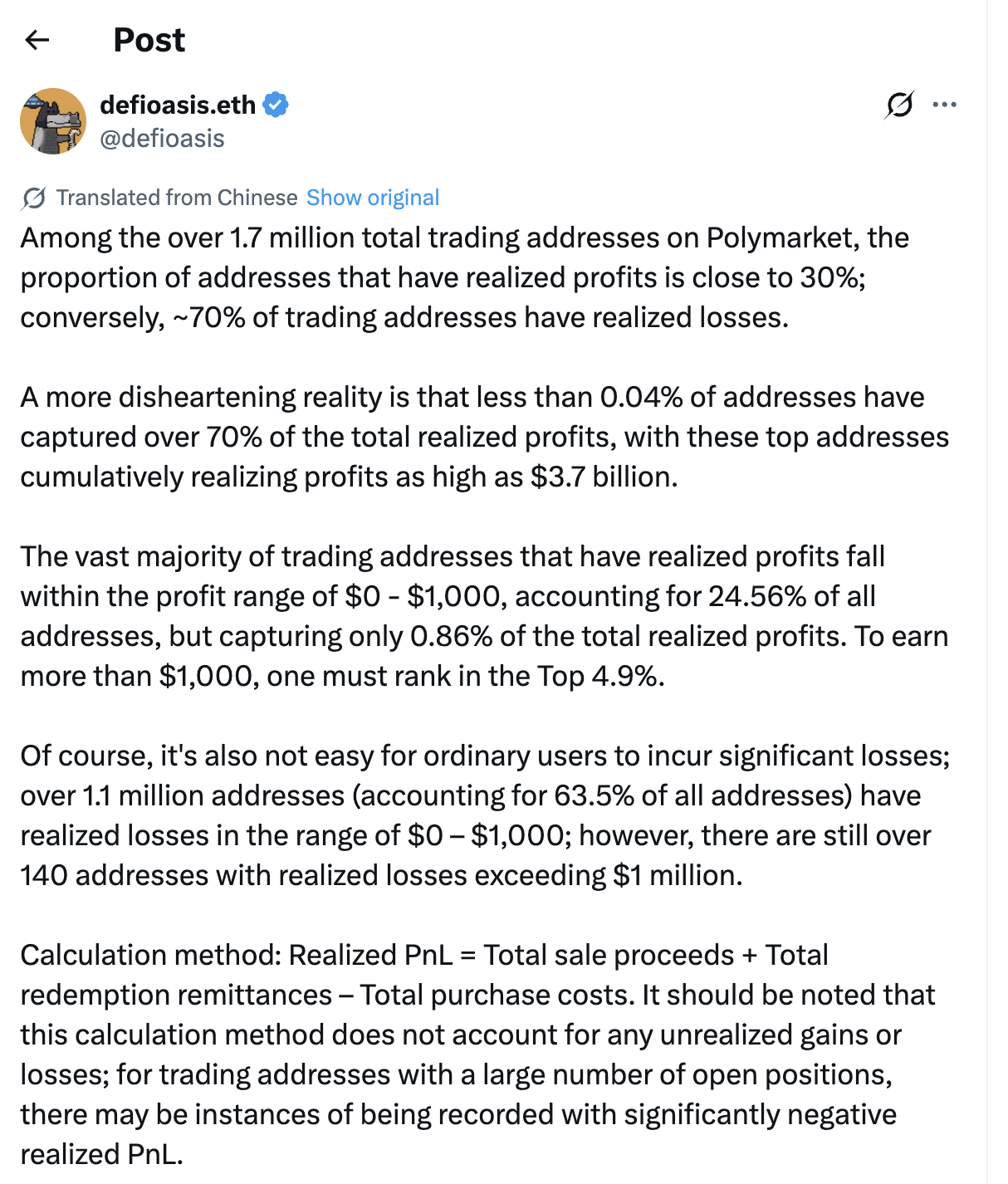
Most profitable users earned very little. Addresses with realized profits between $0 and $1,000 account for 24.56% of all traders, yet they had just 0.86% of total profits.
Breaking past $1,000 in realized gains places a trader in the top 4.9% of all addresses, highlighting how hard the profitability curve becomes beyond casual participation.
Prediction markets as information infrastructure
One overlooked interpretation of the data is that Polymarket is increasingly functioning as an information infrastructure. Casual traders express opinions and sentiment through small bets, while sophisticated players extract value by aggregating that information, managing risk, and arbitrage inefficiencies.
In this sense, losses among smaller users may represent the cost of participation in a market that continuously prices collective expectations. The small average loss size suggests users are effectively paying for engagement, insight, or entertainment.
An X user said losses were inevitable, “Predicting sports events or cryptocurrency trends is not easy. You must conduct a very in-depth analysis of the events to make predictions, and even then, you may still lose money.”
Additionally, the 70% loss rate aligns closely with figures disclosed by ESMA-regulated CFD brokers in Europe, where 62% to 82% of retail accounts typically lose money. The similarity indicates that prediction markets follow long-established patterns seen wherever retail flow meets professional trading infrastructure.
As prediction markets expand alongside platforms such as Kalshi, these dynamics are likely to intensify rather than disappear.